In the kaleidoscopic world of K-dramas, where the tears flow as freely as the soju, there’s one thing that might have you scratching your head. No, it’s not how everyone has perfect skin (though, seriously, what is their secret?), but rather the honorifics that pepper every conversation.
Image courtesy of To.Jenny and YouTube
Why Honorifics Matter in Korean Culture and K-Dramas
If you’ve found yourself wondering why everyone isn’t just on a first-name basis, then, my friend, you’ve just uncovered the cultural treasure chest of Korean titles.
Honorifics are the linguistic bread and butter of Korean society, like the GPS guiding you through the complex highways of social interactions.
They are a crucial part of the language that tells you who’s who in the status zoo.
.
.
They are a crucial part of the language that tells you who’s who in the status zoo.
From the deferential ‘Sunbae’ for seniors to the respectful ‘Sajangnim’ for the big boss, these titles aren’t just fancy add-ons. They’re essential to navigating the K-drama social labyrinth.
Watch Honorifics Scene
To.Jenny
Oppa and Noona Speech That Signals Romance
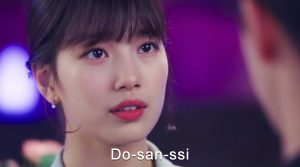
Ever notice how the doe-eyed heroine calls her knight in a sleek suit ‘Oppa’ instead of ‘Hey, you’?
That’s not just a term of endearment. It’s a signal of her affection wrapped in a cocoon of respect. And when it’s used, it usually means there’s some heart-fluttering romance brewing faster than instant ramen at midnight.
But why such a big deal about honorifics?
It’s simple.
In K-dramas, where every glance and gesture is a clue, honorifics are the silent narrators. They whisper hints about personal histories, social standings, and relationship dynamics without the need for a flashback sequence.
In K-dramas, where every glance and gesture is a clue, honorifics are the silent narrators. They whisper hints about personal histories, social standings, and relationship dynamics without the need for a flashback sequence.
They’re the unsung heroes that let you know whether you’re dealing with a no-nonsense ‘Ajumma’ or a venerable ‘Halmeoni’.
Dropping Titles the True K-Drama Mic Drop
And here’s the real kicker: when honorifics get dropped, it’s as significant as the dramatic rain scene that seals a couple’s love.
It’s a plot twist served up hotter than a plate of tteokbokki. You best believe that’s going to ripple through upcoming episodes like a stone thrown in a serene Han River.
And here’s the real kicker: when honorifics get dropped, it’s as significant as the dramatic rain scene that seals a couple’s love.
It’s a plot twist served up hotter than a plate of tteokbokki. You best believe that’s going to ripple through upcoming episodes like a stone thrown in a serene Han River.
Watch K-Dramas Smarter With Honorifics
Now, think about it. When was the last time you got a promotion or a heartfelt thanks, didn’t it feel good to be acknowledged? That’s the power of honorifics in K-dramas – they’re the nod of recognition, the pat on the back, the silent applause for life’s little victories.
.
.
So, whether you’re a seasoned K-drama aficionado or a curious newbie dipping your toes in the Hallyu wave, understanding honorifics can be your gateway to a deeper appreciation of the genre.
It’s the difference between just watching a show and really getting it.
Do you have an ‘Oppa’ or ‘Unnie’ in your life? Ever wished you could navigate social waters with the grace of a K-drama lead?
Share your experiences or just drop a comment below – I’d love to hear how honorifics play out in your world.
And if this peek into the K-drama honorifics has sparked your interest, go ahead and share this with a fellow drama lover. Who knows, you might just help someone crack the cultural code on their next K-drama marathon. Happy watching, chingus!
K-Drama Honorifics Cheat Sheet Quick Meanings
.
.
Use this while you binge. Words are bolded for quick scanning. Meanings are simplified the way fans use them.
Oppa. What a woman calls an older male. Older boyfriend. Older male friend. Flirty energy if romance is brewing.
Unnie. What a woman calls an older female. Big sister vibe. Warm and protective.
Hyung. What a man calls an older male. Brotherhood energy. Loyal and steady.
Noona. What a man calls an older female. Can be teasing. Can be flirty. Often melts into romance.
Sunbae. Senior at school or work. Higher entry year. Respect baked in.
Sunbaenim. Sunbae with nim for extra respect. Common in formal scenes.
Hoobae. Junior at school or work. Lower entry year. Often eager. Sometimes terrified.
Office and Workplace Titles
Sajangnim. Company president or owner. Big boss energy. Bow a little deeper.
Daepyonim. Representative director. Very senior executive. Think top brass in suits.
Isanim. Company director. Board level aura. Likes reports on time.
Bujangnim. Department manager. Middle management. Power plus paperwork.
Gwajangnim. Section chief. Often the no nonsense office veteran.
Daerijang or Daeri. Assistant manager. Workhorse of many office dramas.
Teamjangnim. Team leader. The person who runs your team. Manager who rarely sleeps.
Sawon. Staff level employee. The everyday office hero.
Seonsaengnim. Teacher or respected professional. Also used for doctors and tutors.
Uisa nim. Doctor with nim. Ultra polite. Hallway approved.
Gyosu nim. Professor with nim. Campus respect switch flipped on.
Hoesa jang. Company head in older speech. Shows up in period office settings.
Family Elders and Relatives Decoded
Abeonim. Father in a formal way. Also father in law. High respect.
Eomeonim. Mother in a formal way. Also mother in law. Prepare tea and compliments.
Appa. Dad in casual speech. Warm and close.
Eomma. Mom in casual speech. Soft and loving. Also terrifying when angry.
Welcome! I’m Miss Kay, the person behind this site. I call myself a “K-drama scientist.” Silly? Absolutely.😜 Intellectual? Only in my absurdly grandiose K-drama fantasies.🤣 I hope you enjoy your time here and thanks for stopping by.❤️